


Two years ago, after nearly 20 years of living and working in the reinsurance industry in Bermuda, Stephen Weinstein joined the BIOS board as a trustee. Passionate about the island, committed to business development, and keen to promote initiatives and solutions related to the global risk of climate change, he strives to combine these elements. BIOS, he said, is a key player.
BIOS Faculty and Staff to Participate in Virtual Career Fair
May 15, 2021

On June 8, seven BIOS employees will take part in a virtual career fair hosted by the Bermuda Underwater Exploration Institute (BUEI) in honor of World Oceans Day. The event’s theme, “The Ocean: Life & Livelihoods,” is designed to help local high school and college students explore the wide variety of career opportunities that exist in fields related to ocean science.
BIOS Receives U.K. Grant to Study Deep-sea Marine Life
June 30, 2021
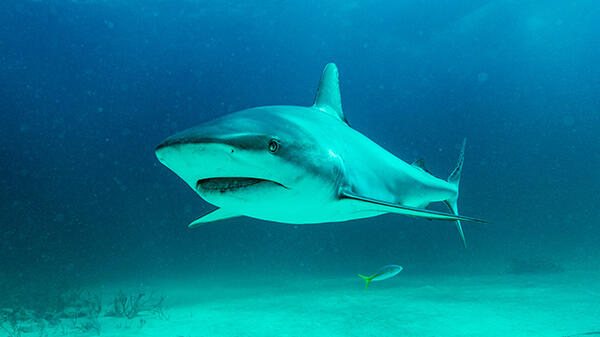
A two-year research project led by the Bermuda Institute of Ocean Sciences (BIOS) aimed at increasing understanding of highly migratory and mobile predatory fishes, including sharks, in Bermuda’s deep-sea waters was one of 31 projects chosen this month to receive funding through the Darwin Plus program. The program, also known as the Overseas Territories Environment and Climate Fund, is administered through the U.K. Government’s Department for Environment, Food and Rural Affairs and provides funding for the “conservation of unique and globally significant environments found in U.K. Overseas Territories.”
BIOS and Living Reefs Foundation Bring Coral Science Into the Classroom
June 29, 2021

Primary and secondary students at Warwick Academy, a private school in Bermuda, now have the opportunity to participate in ongoing scientific research thanks to a partnership between BIOS, the school, and the Living Reefs Foundation (LRF), a Bermuda-based non-profit organization. The project is one of the first at the Academy’s newly-constructed waterfront Marine Science Center, allowing students to learn valuable laboratory skills and play a role in restoring coral reefs in Castle Harbor that were damaged by the development of the airport in the 1950s.
Student Field Trips Resume at BIOS
June 28, 2021

After months of precautionary cancellations due to the pandemic, BIOS staff hosted several school groups on campus this June for marine science studies that complement public and private school curriculums.
Acting U.S. Consul General Tom Edwardsen Visits BIOS
June 27, 2021

Acting U.S. Consul General Tom Edwardsen visited BIOS on June 22 for a tour of the Institute led by President and CEO Bill Curry. The two-hour tour gave Edwardsen, who is expected to remain in his post until this summer, an opportunity to learn about BIOS’s research and education programs.
Bermuda Ocean Prosperity Programme (BOPP) Celebrates Second Anniversary
June 15, 2021

In 2019, BIOS joined efforts with the Government of Bermuda and the Waitt Institute to form the Bermuda Ocean Prosperity Programme (BOPP). This innovative partnership was designed to leverage the partners’ various planning, legal, advocacy, strategy, and scientific expertise to protect 50,000 square miles (90,000 square kilometers) within Bermuda’s marine protected areas to preserve marine biodiversity and ensure economic resilience for the island’s ocean economy.
Research at BIOS Leads to Undergraduate Thesis Prize at Princeton
July 31, 2021
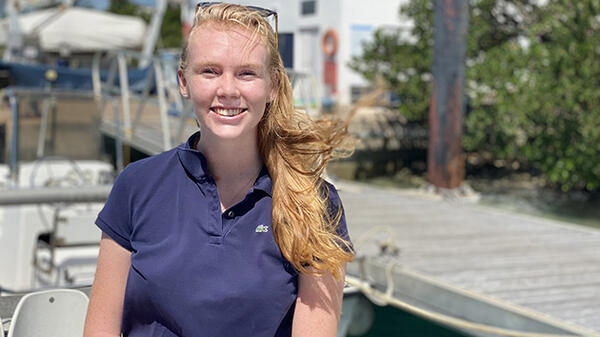
Emma O’Donnell, 22, graduated this past spring from Princeton University (U.S.) with a Bachelor of Arts in ecology and evolutionary biology, with high honors. Her undergraduate thesis, “One Fish, Two Fish: Measuring Patterns of Reef Fish Biodiversity in Bermuda Using Environmental DNA Metabarcoding,” was based on research she conducted at BIOS, and it earned her the Princeton Ecology and Evolutionary Biology Prize for Best Thesis in Ecology.
Pair of NASA Grants Awarded to BIOS Scientist
July 29, 2021
Earlier this year, Eric Hochberg, a reef systems ecologist at BIOS, was awarded two grants from the National Aeronautics and Space Administration (NASA) to continue lines of investigation stemming from the four-year NASA COral Reef Airborne Laboratory (CORAL) mission. Hochberg was principal investigator of CORAL (2015–2019), which utilized a state-of-the-art airborne sensor, called PRISM, to produce the first comprehensive assessment of reef condition for a large portion of the world’s reefs.
A Summer of STEM
July 28, 2021

Each year BIOS selects a handful of qualified Bermudian students to participate in the Bermuda Program. The summer internship opportunity pairs participants with BIOS faculty and scientific staff to work on research projects in the fields of science, technology, engineering, and mathematics (STEM), with a focus on marine and atmospheric sciences.