

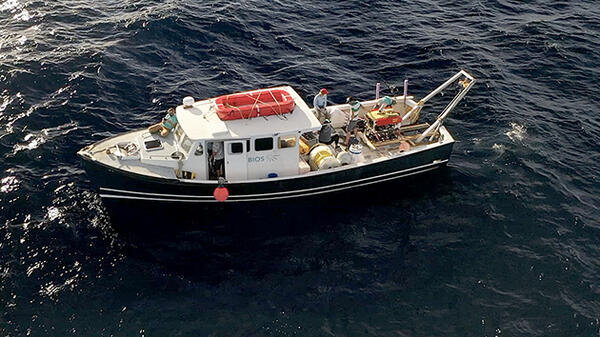
Oceanographer and ocean engineer Brennan Phillips runs the Undersea Robotics and Imaging Laboratory at the University of Rhode Island (URI) in Kingston, Rhode Island, where he and his students specialize in creating novel systems for oceanographic research and deep-sea exploration. He is also a familiar face at BIOS, having spent time at the Institute in 2019 testing the development of a controllable, miniaturized camera system for deep-sea exploration, called DEEPi.
When Saturdays Became Learning Days
January 27, 2021

When the ongoing pandemic scuttled Maya Leighton’s plans this fall to attend a university overseas, she instead enrolled for a year at Bermuda College. There, a professor noted Leighton’s commitment to marine sciences and suggested a unique opportunity. How about spending Saturdays at BIOS, learning about coral reefs, marine microplastics, plankton, and mangrove restoration on island?
How about Studying this Summer in Bermuda?
April 13, 2017

This summer, BIOS will offer courses in Modern Observational Oceanography, Coral Reef Ecology and a new course: Coral Reef Optics. Each course offers a unique opportunity for students to study abroad and conduct fieldwork in Bermuda’s marine ecosystems. Applications are due April 14. For more information, including how to apply, see the course flyer or visit /education/summer-courses
Working Around the Weather
March 13, 2017

Understanding our planet and how it functions, as well as the impacts that human activities have on it, requires frequent and extended forays into the field to yield valuable data and observations. The COral Reef Airborne Laboratory (CORAL) investigation is a prime example. The three-year mission, funded by the NASA Earth Venture Suborbital-2 program, is conducting airborne remote sensing campaigns, along with in-water field validation activities, across four coral reef regions in the western and central Pacific Ocean.
Five Years, Five Students—and a Fine Paper to Show
March 13, 2017

Since its beginning in 1903 as a field station for students and scientists at Harvard University and New York University, BIOS has hosted hundreds of students from colleges and universities around the world. Over the years, students conducting research at BIOS have used their experiences as springboards for acceptance into graduate degree programs, a variety of technical and research positions (both at BIOS and abroad), and—frequently—a scientific publication in a peer-reviewed journal.
Tiny Algae, Surprising Findings
March 13, 2017

Chemical oceanographer Nick Bates’s ongoing study of the ocean-atmosphere interface sheds light on a group of tiny, beautiful marine plants called coccolithophores, which have been found to release carbon dioxide into the atmosphere in regions near Antarctica.
Calling All Volunteers
March 13, 2017

Like to snorkel? Interested in supporting emerging marine engineers? Several dozen volunteers from BIOS and the Bermuda community are needed to assist on Saturday, April 22, as 27 teams of middle school students test their mission-tasked Remotely Operated Vehicles (ROVs) during the annual island-wide robotics challenge.
A Royal Visit to BIOS
March 12, 2017

Prince Edward, Earl of Wessex, toured BIOS this month during a visit to Bermuda to celebrate the 50th anniversary of the country’s Duke Of Edinburgh International Award.
Celebrating 25 Years of Undergraduate Research Success at BIOS
February 12, 2017

In 1991, a group of undergraduate students arrived in Bermuda to spend a semester with BIOS faculty and staff who mentored their independent marine science research projects. The program, known as Research Experiences for Undergraduates, or REU, was designed to provide a semester-long, rigorous research experience enhanced by field trips on land and at sea. Since then, nearly 200 university students have participated on a variety of projects, with themes ranging from climate change to coral reef ecology. Their work culminates in a final, formal presentation to BIOS faculty and staff.
BIOS Scientists Make Room for Flumes
February 12, 2017

When scientists study coral reefs, they are often interested in figuring out key components of reef health; specifically, primary production—or photosynthesis—and calcification, the rate at which new reef growth occurs. For decades this has meant time and labor-intensive fieldwork, with scientists documenting global reef condition and linking what they see underwater with lab-based experiments and measurements.